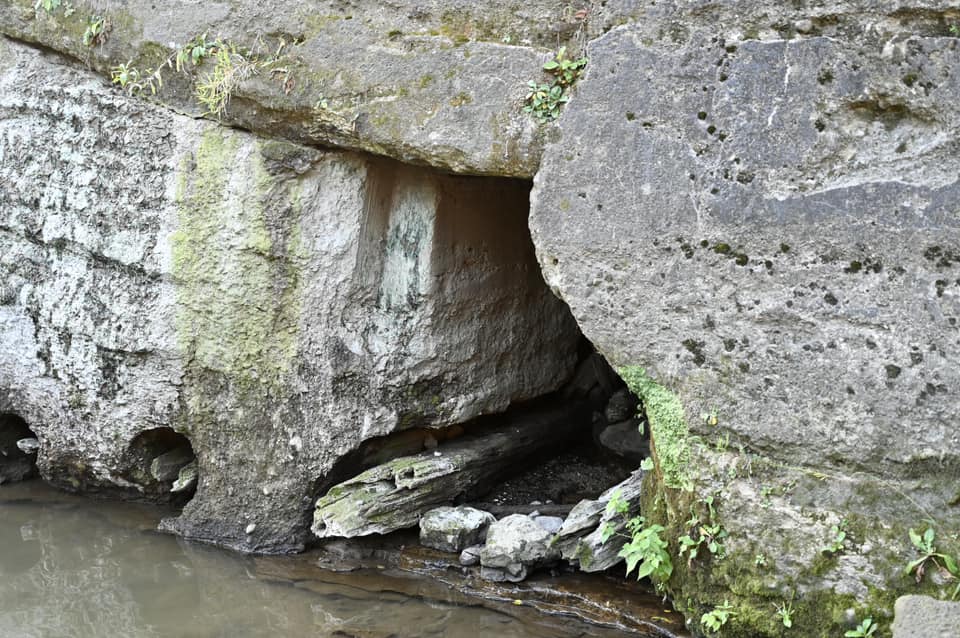
Facebook Post by Brendan Kearns – October 7, 2023
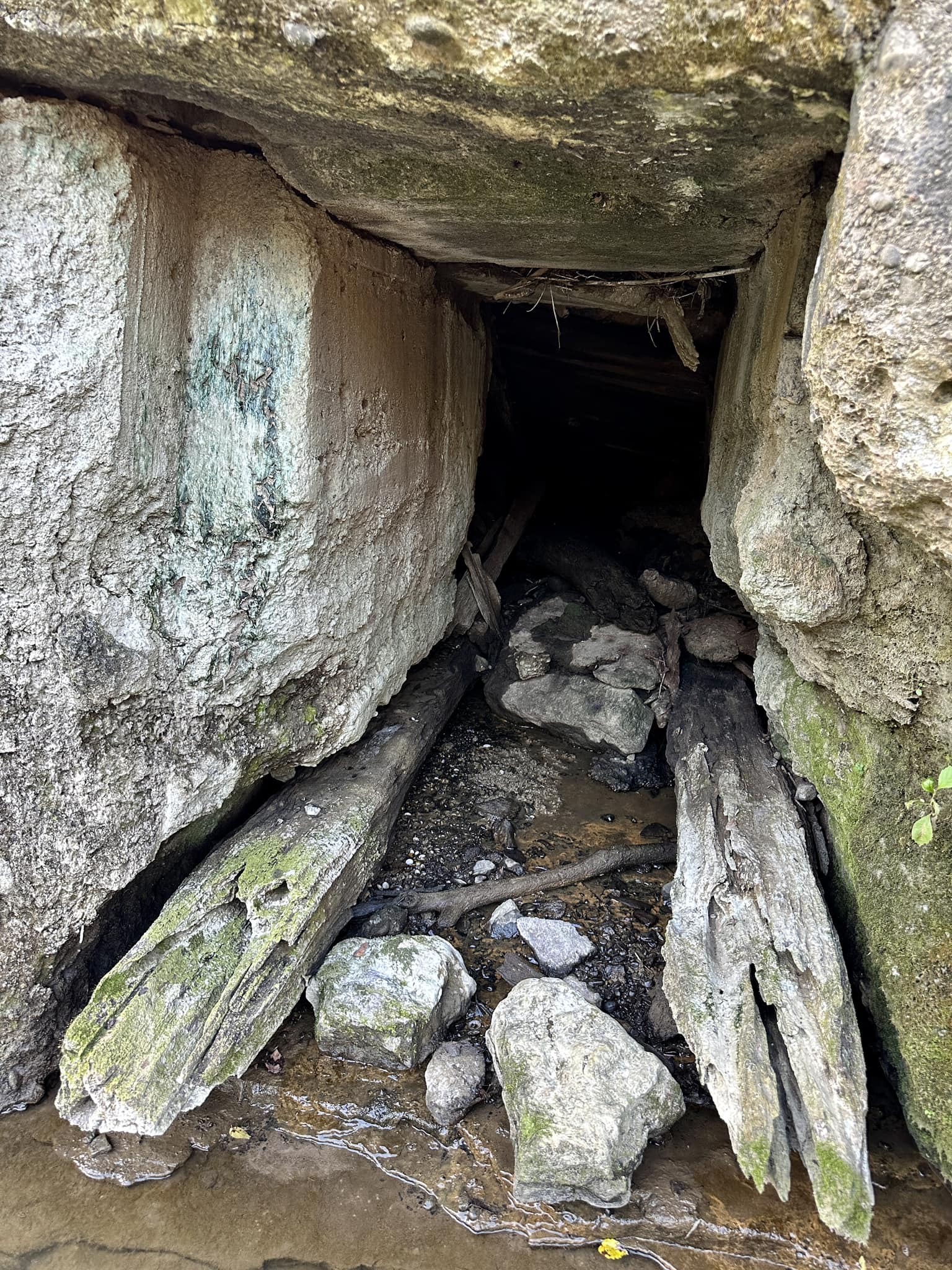
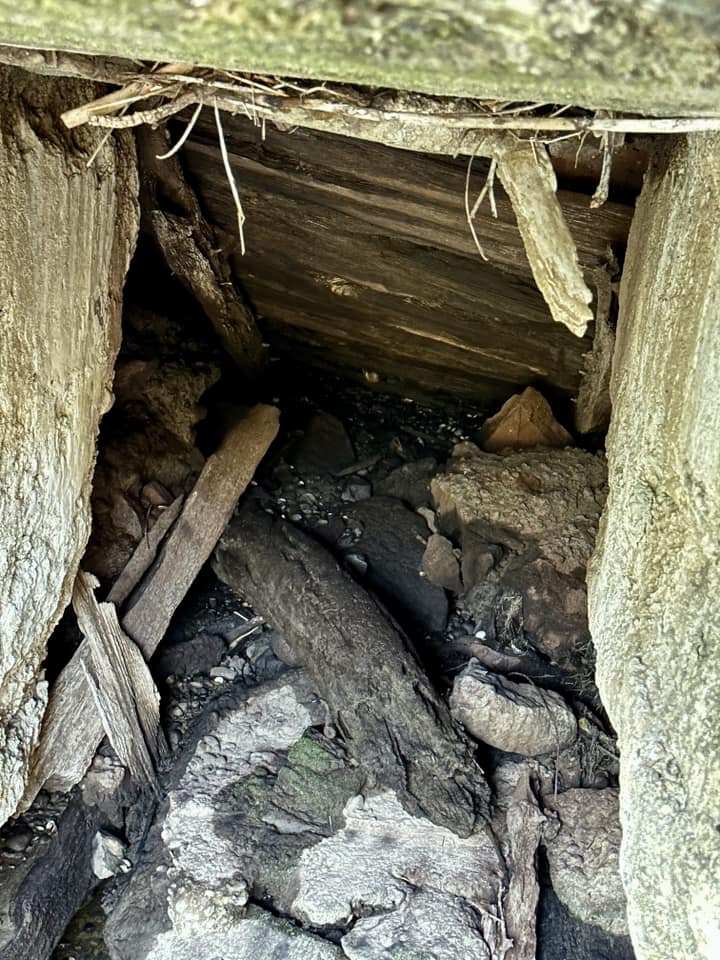
The Tunnel At Markle Mill Dam Park.
Or should I say “The tunnel at Markle Mill Dam Park?”
Let me answer this question. Is there a tunnel? Yes, and no.
In recognition of the DNR ordered removal of the dam scheduled for October 9, 2023,, let me take this opportunity to provide some historical facts.
We have all heard the stories about a tunnel that runs from the home of the Markle Family to the mill. (the current home, built in 1846, was the second home) There are other stories that there was an actual “underground railroad”. In an effort to not come across as condescending, let me try this. The “Underground Railroad” was not a railway that went underground. Let’s move on.
As a north-ender who visited the site many times as a little kid with my parents to a teenager who occasionally stood right under the railroad ties of the trestle as trains went over, to an adult who enjoys photographing and fishing at the Markle Mill Dam Park. (Man that was a long sentence)
I attended several Ouabache Land Conservancy meetings in the Markle home, and the former owner Sallie Cox took us down in the basement to show us, that there was not a tunnel.
When I became Commissioner, I took advantage of being able to access as many historical documents as I could. For me, it was a treasure trove of history. I often shared those treasures on my social media posts. I built a personal file, scanning documents relative to Markle Mill Dam Park.
One of them is a archeological study commissioned by the Vigo County Commissioners in 2004. Click here to read.
The study focused on several key things. The history relative to Native American presence, the origin of the mill and dam, the sites role in the Underground Railroad movement and trying to see if there was in fact a tunnel. The 80 page document made it pretty clear. No tunnel. Ground penetrating radar was used, along with other methods. But………
My friend and former Vigo County Parks Superintendent Keith Ruble once told me a story about the Inspection Tunnel of the dam. But before we get to that story…… There are at least three known modifications of the dam. The original dam was constructed in 1816. From the study: “The dam, which was needed for the millrace, was approximately 100 yards wide and formed a pool six feet deep. It was constructed by driving white oak beam pilings into the rock bottom, and then facing it with white oak planks. The dam was pinned together with wooden pegs, as metal hardware would rust (Andrews 1973; Calvert 1994. The wooden dam, though in need of regular maintenance, held for about 100 years until it was rebuilt with concrete (around 1912).” This is when the inspection tunnel may have been installed. It is on the upstream side and the purpose was to simply make sure the dam was in good condition. I am unsure if the tunnel goes the full 300’ or just a section. But……from the 2004 report “Certainly, given the architecture of the dam, no tunnel passed through it.“
We will soon know when the demolition starts.
Okay, back to the story….. Keith shared “I attempted to go inside of it, but as soon as I noticed a ball of snakes, I got the heck out of there!” Not too long ago, I attempted to go in it. It was neat to see, and the photo of this post shows it. More photos are in the comments. You can see the old timbers. You can clearly see the planks. But there wasn’t much more than the entrance. The same upright timbers are now exposed. Water is protruding through them as the dam is failing. (You may be reading this after the dam has been removed)
So yes, there possibly was a tunnel at the Markle Mill site. It was just inside the dam. And it may have been very unremarkable. Unlike how remarkable this place is to many Vigo County residents.
A few excerpts from the 2004 study:
The Markle House stayed in the family until 1951 (Calvert 1994), when Mabel Markle Weir sold it to Floyd “Tom” and Georgia Larison. The Larson heirs sold it to the Hulman family in 1977. The house and three acres were then donated to the Vigo County Historical Society. In 1979, the house was accepted into the National Register of Historic Places. House renovations were undertaken by the VCHS at a cost of around $30,000 (Ciancone 1978), with Shelton Hannig doing the majority of the contract work. Improvements included a new well, The house and three acres were then donated to the Vigo County Historical Society.
In 1926, Markle’s Mil was designated by the Indiana Historical Society as the oldest mill in the State (Polley1935; Calvert 1994; Miller 1999). Around 1930, there was some discussion of developing the mill into a state park (Caldwell 1930). Newspaper articles speculated the development of cabins and other park facilities on the property.
At some point shortly after the fire, the mill tract came into possession of the Hulman family, who leased it to Otter Creek Township for one dollar a year, to be used as a park (Calvert 1994). Vigo County Parks agreed to incorporate the mill tract into its program in 1999
The house was sold to Don and Sallie Cox in 1983. Though a witness said a large metal plate was placed over a tunnel entrance in the basement (Kersey 1977), no evidence of walled-over tunnel was found.
Markle’s Mill Park was renovated to some extent in 1983. Approximately 40 students from Terre Haute North Vigo High School dug a diversionary trench as to direct flow away from the dam, and patchedthe dam with concrete (Christenberry 1983). A community group called Committee to Save the Dam” was also formed in 1983, headed by Mr. Nick Peters. Through fundraising and philanthropic donations of money, materials, equipment, service, and volunteer labor, they completed a series of renovations designed to stabilize and preserve the mill and dam and to minimize future impacts to them (Chait 1983). A general cleanup was also conducted at this time. From newspaper articles and photos (Chait 1983), it seems that the lower concrete structure that served as the mill office/store/gas station foundation attached to the north end of the mill was torn down at this time, as was the concrete porch that flanked the west length of the building, in addition to the concrete structure that served as the southern addition to the mill. Inmates from the County jail were assigned the task of breaking andclearing old slabs of concrete and rock in 1999 (Hathaway 1999).
It should be noted that while a possible unverified trace of a potential tunnel was identified as leading from the mill (Feature 3), there was no analogous signature identified on the Cox property, leading into the 1846 Markle house. The area examined, that being the entire house frontage that lied between the house and mill, would have incorporated the potential tunnel if this trace is projected as a straight line from the mill. However, it is possible that certain conditions may have obscured the trace from the magnetometer, or that a possible tunnel was too deep for the magnetometer to detect-any number of things could be responsible. Nonetheless, it is just as likely that no tunnel existed. Simply said, the presence of a tunnel cannot be verified or refuted at this point. The Cox family, the current residents, state that there is no apparent tunnel egress in the basement of the Markle house, thus diminishing the likelihood of its existence. Certainly, given the architecture of the dam, no tunnel passed through it.
THE FUTURE OF MARKLE MILL-RECOMMENDATIONS
This investigation was archaeological in nature, with archival research involved as well. As such, recommendations for future investigations will be largely confined to those in the archaeological domain.
Clearly, the mill’s stone foundation walls and the dam are in a poor state of repair. Significant deterioration is evident in just the last 30 years. Efforts should be directed toward the stabilization and preservation of those structural elements that are extant. Other agencies more qualified to address this issue should be consulted. Ideally, funding would be procured to rebuild the entire mill and dam complex, though such funding may be difficult to marshal ni the current economic climate.
Future archaeological investigations would be tied tospecific future developments within the park. As Markle Mill is listed on the NRHP and is designated as an archaeological site, 12Vi893, no developments should be made without consultation from the archaeological community amongst
other involved parties. The larger the scope of development and area of impact, the larger would be the scope of archaeological investigations, with the archaeology to precede the development. Of course, contracting further archaeological investigations for their own sake is meritorious as well. Specific courses of archaeological action can be designed when park development plans are clarified. Test excavations of targeted areas and “ground truthing of anomaliesidentified in themagnetometer
study should be anticipated should development come to fruition.
Certainly from an archaeological perspective several features made evident in the shovel probe testing and magnetometer survey are of considerable interest, and some of these would probably be of keen public interest as well.
From the latter study, the entity identified as Feature 3 could-and the term could cannot be emphasized strongly enough-be a trace of the alleged tunnel that ran between the mill and the later Markle house. There is no guarantee that the image does in fact represent the tunnel however tantalizing the possibility may be. It must be kept in mind that the current residents state there is no evidence of a tunnel egress in the basement of the house, thus casting grave doubt on its existence. Its presence would thus require additional investigation. Anomaly 2 is in all likelihood the foundation ofa barn that was constructed late in the mill’s history by its last owner, Charles Hansel. Anomaly 1may consist of late foundation constructs as well. Anomalies 6 and 9 were enigmatic, and as they are known, no significance assessment of them can be made. It would also be interesting to remove the sediment from the bottom of the mill and get
a better idea of the underlying floor, though test results revealed not much more than wall rubble.
No further archaeological investigations are recommended for any developments on the east bank of Otter Creek. It has endured significant impact and holds virtually no archaeological potential.
 The Markle House
One response to “Brendan Kearns: Tunnels at Mill Dam?”
[…] has done a good deal of investigating this topic and shares his research and documentation in this terrific post – well worth your time if you’re interested in further evidence .(or rather the lack of […]
LikeLike